Skip to content

Population and Community Ecology (PACE) Lab

  • Home
  • Staff
  • PACE Lab News
  • Urban Biotic Assessment Program (UBAP)
  • Amphibian and Reptile Conservation (ARC)
  • Freshwater Mollusk Ecology and Conservation (FMEC)
  • Environmental Education Program (EEP)
  • Research
Posted on April 22, 2021April 22, 2021 by JMM

UBAP ornithologist wins Best Poster Award

UBAP ornithologist Asya Rahlin presented a poster “Spatial and temporal drivers of marsh bird occupancy in an urbanized matrix” at the Natural Resources and Environmental Sciences Symposium and earned the award for Best Poster.
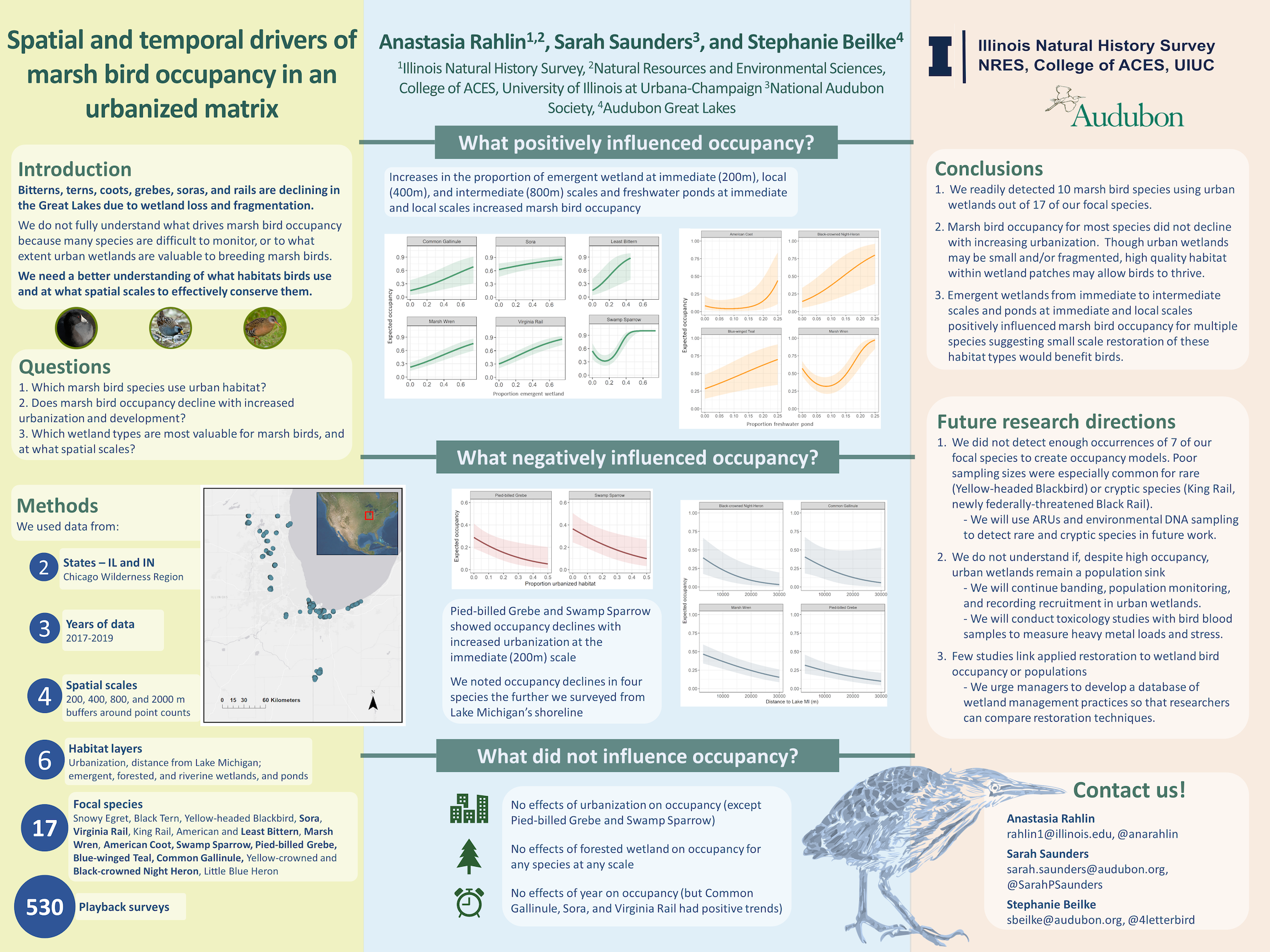
Read more about Asya’s research

CategoriesBirds, Presentations, UBAP, Uncategorized Tags#INHSPACELAB, conference, Marsh Birds, Women in Science

Post navigation

Previous PostPrevious 2021 NRES Symposium
Next PostNext Ornate Box Turtles at 2021 Virtual Nachusa Science Symposium

Categories

Recent Facebook Posts

INHS PACE Lab

5 days ago

INHS PACE Lab
It's officially Orange and Blue Days! The countdown is on to try to meet our fundraising goal! It costs on average $750 per day to bring our program to schools. Our goal to raise $3,000 would provide for 4 schools to experience the Traveling Science Center, a museum field trip in their own school yard!Link in the comments! ... See MoreSee Less

Photo

View on Facebook
· Share

Share on Facebook Share on Twitter Share on Linked In Share by Email

INHS PACE Lab

6 days ago

INHS PACE Lab
A couple weeks ago, we described the Bradford Assay and how KC is quantifying protein in pollen. Protein is only part of the nutritional story for pollinators, so we are now adding the sulfo-phospho-vanillin (SPV) assay to measure total lipids in pollen collected directly from plants and from bumble bee corbiculae. The SPV assay is also a colorimetric method where lipids react with sulfuric acid and a phospho-vanillin reagent to produce a pink color, and the intensity of that color corresponds to lipid concentration that can be quantified with a spectrophotometer.Lipids are a vital energy source for developing larvae and foraging workers and play an important role in maintaining long-term energy, supporting larval growth and reproduction, and strengthening immune function. Pollen varies widely in lipid content among plant species, so measuring lipids helps identify which flowers provide high-quality forage. By pairing Bradford assays for protein with SPV assays for lipids, KC can estimate the macronutrient composition of pollen across plant species and landscape gradients. Comparing pollen collected directly from plants with pollen packed into bumble bee corbiculae reveals what bees are choosing relative to what is available in the landscape. The protein:lipid ratio is especially important in bee nutrition research because shifts in that balance can influence foraging behavior, larval development, and colony health. Together, these assays provide a more complete picture of how floral resource quality shapes bumble bee diets and how landscape-types support nutritionally balanced forage. ... See MoreSee Less

Photo

View on Facebook
· Share

Share on Facebook Share on Twitter Share on Linked In Share by Email

INHS PACE Lab

1 week ago

INHS PACE Lab
We’ve invaded the University of Illinois Urbana-Champaign Grainger College of Engineering CU STEAMM fair! Come check out all of the exhibits up here on the north side of campus hosted by Family and Community Engaged STEAMM faces.illinois.edu/ ... See MoreSee Less

Photo

View on Facebook
· Share

Share on Facebook Share on Twitter Share on Linked In Share by Email

Twitter Feed

Twitter feed is not available at the moment.
Proudly powered by WordPress